
This week, the show has two segments.
Pittsburgh Anarchist Book Fair
First up, you’ll hear a brief interview with M, an organizer of the first Pittsburgh anarchist book fair, happening October 24-26 across a few venues in the Steel City
- A list of events (still being updated): https://pizz.ation.ist/
- Facebook event: https://www.facebook.com/events/1327126225660995
As is anarchist book fair tradition, everything will be free.
We’re renting a few spaces, and expecting a few other costs. Sharing that info here so folks can get a sense of what that looks like. If you/others are inclined and able to support, would be grateful for that.
Attached is an image of the break down as of today, and below is a link we’ll update live time as to what costs look like.
https://pad.riseup.net/p/r.ca0a70f3bd595bb58b9daab4e6d9a576
You can buy a beautiful book fair shirt (design by the illustrious N.O. Bonzo), or simply donate. Venmo: @pghbookfair. (If you’d like a shirt, indicate size in the note – S-3XL; if yr just donating, any emoji or strange note is fine!) Feel free to message for other ways to donate.
“Gen Z” Uprising In Nepal
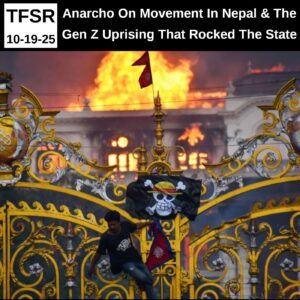
Then, an interview that I conducted with Anarcho, a member of the Black Book Distro collective out of Kathmandu, Nepal, about the protests and aftermath of the September 2025 “Gen Z” anti-corruption protests that ousted the prime minister, released prisoners and left the parliament in smoldering ruins.
Because we don’t follow a strict chronology of events, we’re including a few articles linked in our show notes for further study. We worked heavily off the interview with members of the Black Book Distro and CrimethInc, which is among those in our show notes.
- https://www.anarchistcommunism.org/2025/09/13/nepal-a-grassroots-uprising/
- https://organisemagazine.org.uk/2025/09/09/nepal-communications-international/
- http://www.srilankaguardian.org/2009/12/anarchism-in-nepal-2006-2009.html
- https://www.gofundme.com/f/black-book-distro-anarchist-library-in-nepal
- https://kathmandupost.com/columns/2025/09/15/welcome-to-the-eros-effect-gen-z
- https://open.spotify.com/episode/464iPIxwdVLT3BVLoepsKj
- https://crimethinc.com/2025/09/22/nepali-anarchists-on-the-toppling-of-the-government-an-interview-with-black-book-distro
. … . ..
Featured Track:
- Go Anarchist Go! by Rai Ko Ris from Ungovernable Mountains
. … . ..
Transcription
TFSR: Would you please introduce yourself for the audience with any names, affiliations that you have, any location information or anything else that will help the audience understand who I’m talking to?
Anarcho: A lot of my friends know me by Anarcho, and I am based in Kathmandu, Nepal. I grew up in Kathmandu, and have been here trying to make some mess since some time.
TFSR: Somebody has to make a mess, right? And could you talk a bit about Black Book Distro, and also about your impression of anarchist history in Nepal and what anarchist organizing looks like these days?
Anarcho: So me and my friends, we started Black Book around 2020, when the first lock down ended and before the second started. It was around that time we started it. Since the beginning, our focus was to make it a collective and a library where we can do talks, workshops meetings, organizing, planning. Those sort of thing. In the beginning it was quite small, because before there was another anarchist library. It still is here, but it’s not active, because the person who was running it has moved to UK. That the older infoshop, we just called it Infoshop. There was Infoshop and it was in different part of the town, so we started it in our side.
Talking about anarchist history in Nepal is not that long. It’s also from like 1990’s. That’s when the first punk bands started. Before that, it’s mostly communist history, I would say, because we haven’t found any written documents or anything before that. We are pretty sure there were some anarchists, but we don’t have any proof, so we just say it started from the 90s with the punk movement. Most of the punk movement came from UK, like children of like British coworker army, who went to UK to study or live there, got influenced by punk music and anarchism, and when they came back to Nepal, they spread it around here also. What was the last question?
TFSR: Up until this uprising, what are anarchist organizing or projects you’ve seen around Kathmandu or around Nepal?
Anarcho: It’s only mostly based in Kathmandu, actually- the anarchist projects. There are anarchists in other towns or cities of Nepal as well, but they don’t have a physical space, so they only do things when they’re like gigs and stuff. So the actual solid spaces and organizing is based in Kathmandu. Before the protest, I guess we we’re mostly involved in art, music, radical education. We were doing radical anti-school, which was a six month project where every Saturday, there would be a different topic, or different speakers. We used to do it in the oldest university Nepal, which is in Kathmandu. The university didn’t know what we were actually doing but because we had connection with some communist friends there who had influence, they just got us the permission. So we were organizing anarchist lectures in the university, which was funny. Other than that, it’s mostly intellectuals actually because people still don’t know what anarchism is. There are people who call themselves anarchists, but they usually don’t have any concrete idea. If somebody asked them, like, “Okay, so what’s anarchism?” They’ll be like, “no God, no master” and then be finished. That kind of situation. So we’re mostly focused on more radical literature. Just now, people are actually starting to get more familiar with anarchist literature and history and things. It’s slowly there.
TFSR: It seems to me, as someone who’s been involved in anarchism for a few decades, that where you don’t feel that there’s very much influence- the education and the getting people thinking about anarchistic responses to problems, figuring out what their desires are, figuring out how they can relate to the people that they’re going to organize with and what goals they want to reach- those sort of very basic introductory things feel like an important thing. You build the movement by people figuring out what they want.
Anarcho: True, true. That was one of the big issues, because it kind of became an intellectual left bubble situation, where anarchists think like, “the people will not understand this” or “they don’t care.” So they stop communicating with the masses. I think that happens everywhere, but here too. It took quite a lot of arguments and debates for Black Book to run like it does, because there were friends who were like, “ah, we should not do all these kind of things. There is no point trying to make people understand anarchism. We’ll just be putting ourselves at risk” and those kind of things. There were friends who were like, “oh, we should do this. What are we gonna do with Infoshop being always an underground sort of situation?”
So, yeah, I agree with your thing. I also have been in this movement for a decade and a little bit more now. A lot of things have improved. Actually, I’m quite happy regarding Nepal, in the amount of interest that has increased. It’s mostly always an intellectual bubble. People do need to go and communicate with the masses.
TFSR: Yeah, yeah. And that’s interesting. What you were saying about the history, where it feels like you couldn’t find documentation, but you felt like probably it was there. I feel like in a lot of parts of the world, here as well, it’s been relatively hard uncovering some of the history at times. A lot of stuff just got subsumed under Marxism or the Marxists. In this country, the government would say, “Oh, they’re all communists” and ignore the differences between. Where there were anarchists, oftentimes they would get purged out of parties or pushed to the sidelines as being trouble. As opposed to actually having ideas. I don’t know if that’s a similar thing there, because there has been such a strong history of Marxist, Leninist and Maoist organizing, right?
Anarcho: One of the main reason we say there were anarchists, but we don’t have any proof, is because the Nepali radical movement kind of started together with the Indian independence struggle. When India was fighting for its independence, there were a lot of Nepali radicals who were exiled from Nepal who were there. The Nepali radicals were involved in independence struggle also for India. That’s why Nepal and India has a very mixed up political situation always. Since that time, it’s always been mixed up. India also had anarchists as that time, MPT Acharya and Har Dayal. Those guys were openly calling themselves anarchists and writing books and articles going around. Indian communist, also were anarchists. It has been mentioned in a lot of places. So I’m pretty sure somebody got inspired by anarchism, some of the Nepali radicals there. But either they didn’t write anything, or if they wrote something, it’s lost.
TFSR: So on September 8th, the Nepalese State faced anti-corruption protests so large that within 35 hours, Prime Minister Khadga Prasad Oli of the Communist Party of Nepal (Unified Marxist-Leninist), fled office. These protests, labeled Gen Z protests- as the median age in Nepal is 25 years old- seemed sparked the government attempting to shut down social media following the trending of commentary about corruption and nepotism being rife in the country. Can you talk about the economic and social conditions prior to the protests, and who was out on the streets protesting?
Anarcho: On the eighth and ninth, yeah, it was called a Gen Z movement, and yes, a lot of Gen Z’s were involved. But it was Gen Z and millennials actually, because a lot of our friends were also there. I was there. We were looking around and it was not just Gen Z. It was Millennials there also, and even older folks there were also involved. It was not just Gen Z’s going there. It was just labeled Gen Z because that generation started saying we need to protest on this day. Even the group name was Gen Z. So that’s why it ended up being called Gen Z. I’m not sure about the 35 hour mark, because it’s a conflicting argument. On the eighth, the protest was not to topple the government. The youth were there. It was more than the social media ban. It was against corruption. Actually, the social media ban just ignited the anger of people, because at least if there was social media, people were distracted. Suddenly, nothing is working and people don’t know how to use VPN and things. People suddenly had time to think and get angry, I guess. There was no longer Instagram reels and Facebook reels for a bit. Very fast, within a couple of hours, everybody had downloaded VPNs. So the first day, was not a protest to topple the government. It was supposed to be a peaceful protest. Police killed a lot of people, and then the second day was to topple the government. People were so mad. They were like, “Okay, we’re gonna burn everything down.” So in my perspective, it didn’t even take eight hours to topple the government. Protests started in different parts of the country by eight or nine in the morning. Then by two or three, the prime minister had resigned, the military and the police had surrendered and people burned everything down. So if you look at both of the protests, we can say 35 hours, but the actual time needed to topple the government was eight hours.
TFSR: Okay, that’s a good point. Can you talk about the timing of starting the bookstore in 2020? It makes a lot of sense that people who are in lock down during the beginning of the covid pandemic would be feeling isolation and be thinking about what projects can we build to bring people together in the ways that we want. That also was coming within a year of the giant 2019 anti-corruption protests that people were involved with. I wonder if you could talk about what complaints of corruption people have? With this hashtag, #nepobaby, who are they talking about? How does class structure work? How does political power work in Nepal, and what brought people to take extra-parliamentary action in the streets in order to, at first protest, and then secondly, after all the killing, take down the government?
Anarcho: Most of the youths, like the actual Gen Z generation, started getting politically aware from the Enough is Enough protest during lock down where the government was not doing anything for the people. People were basically starving in their houses. A lot of youths went out and started protesting. It was supposed to be peaceful, and the protest was so peaceful that they were even maintaining the distance of two meters. The youth were standing in the street with a two meter distance between them and just holding posters and things. But then as typical, police just started throwing tear gas, and things became violent. Nobody died during that time. That was a starting point for a lot of Gen z’s. Now, when I’m talking with the younger folks who are more involved in protest, or political issues, for many of them lock down and Enough is Enough was the starting point. With the nepo baby thing, it’s just Nepali frustration. Most of the Nepali, they have to go and work in Dubai and Saudi and Malaysia, and end up dying there a lot of time, just to make that stupid stadium for the World Cup. Nearly 5,000 Nepali workers died during the whole process. And the Nepali government does nothing about it. Even Nepali people don’t know about it, actually. It’s not talked about that much in media. People know workers are coming back in boxes, a lot of them.
My friends were researching how many Nepalese people died, and it was like 5,000. Which is ridiculous. So those are the contrast. Most of the youth, they end up working in those harsh conditions. Those who have money end up going to Europe, US, Australia. Then there are the children of the politicians who don’t have to work. Some of them go and study in Harvard, those types of places, posting their Louis Vuitton, their fancy cars and all their travels, and #PeaceLove in their posts and things. People were just quite frustrated. So Nepali Gen Z picked up on that trend. I think it started in the Philippines, the nepo baby trend. And Nepal also started it. Then people just suppose that because of the nepo baby trend, where people were specifically targeting politicians and their children, that the social media ban happened. So, yeah, nepo baby kind of started it actually. With the social media ban, people got so frustrated, not because they can’t use Facebook, but just seeing how much the government doesn’t care about the people and all the corruption, and when people talk about it and they ban social media. The group was called Gen Z’s. The people doing the main organizing in the beginning, most of them are Gen Z but maybe not all of them. It was supposed to be peaceful, but it gathered such a large crowd that it was not possible. We kind of knew that there would be a riot for sure. When 10-20,000 people gather in the street, then I don’t believe that it will be peaceful, and especially if they’re trying to reach the parliament.
TFSR: A lot of riots anyway, are reactions to police over reactions and fear-based increases in the amount of violence that they use against a crowd. That’s a good way to get a crowd to riot.
Anarcho: It’s quite intense, though, because Nepali Police haven’t killed people like that before. Yes, during the Civil War, there was actual war so at that time, people were killed. But after that Nepal has seen a lot of revolutions. Even when toppling the monarchy, the death count was 12 or something, and the death count now is at 75.
TFSR: With what you were talking about with people having to go abroad for work, that was one thing that I was wondering about. These articles that I’ve read have talked about that. It makes sense if the majority of people in the streets tend to be younger, because they’re affected by economic insecurity or lack of opportunity. Then, if people are, because of that economic like lack of opportunity, having to go abroad for dangerous jobs that don’t pay very well, maybe they move abroad, start communities there, families, what have you, or maybe they die, as you were describing with the football stadium construction, and then you mentioned the Civil War too. Are these contributing factors to why the average age in Nepal is so young?
Anarcho: Yes, and no. I’m not sure exactly why it’s like that but a lot of youths are not in Nepal. Nepal’s brain drain is 70% or something. 70% of the educated youths are not here. So the Gen Z’s that were actually participating are either jobless or have some job that is not that good or we’re trying to go abroad. A lot of people who died during the protest, nearly all of them, were planning to go abroad.
TFSR: So starting on the ninth according to what I was reading, there were a number of arsons against the houses of current and former politicians from a number of different political parties. Does this represent an observable anti-political strain in the protests, or does this seem to be concerted act of one faction or another?
Anarcho: It’s a mix of both. There was a lot of public anger. People in Nepal hate the government. There was always this subconscious thing in their mind. Anytime people are angry with politics (it has been many, many years) people used to say “we should burn down the parliament.” That was a very common thing in Nepal. “Go and burn down the politician houses.” It was always in the imagination before, but on the ninth it actually came out. A lot of people who died in the first day were actually students, including students in school uniform shot in the head or in the chest. A lot of millennials were there. Especially with the kids dying in school uniform, people were like, “Okay, now let’s go burn it down.” But that rage was also sabotaged by political factions. They were just waiting for something like that to happen.
When the Supreme Court got burned down, we are pretty sure it was done by political factions, to get rid of evidence that could be used against them. Also, a lot of prison breaks. In one of the prison breaks, the head of one of the political parties was there, Rabi Lamichhane. That prison break was definitely organized to break him free. He came out and then tried to get back into politics. He said that the police there actually let him out and created fake papers. People found out it was fake, and all the country was like, “go back to prison.” So he again, went back to prison. There were things like that, the Supreme Court, the prisons and other ministries, for sure. So it’s mix of both. Let’s say 80% was public anger, because we went around all of Kathmandu, and it was normal people just going and burning down police stations and burning down politician’s houses or the Parliament, or those countless ministries. People were just singing and chanting and clapping, watching everything burn down. It was like, euphoric. It’s mixed.
TFSR: Yeah, I bet it was euphoric, especially if for years, people were just like, “you know, we should really get rid of that thing.” My impression from the Crimethinc interview that some members of Black Book did, is that there are a variety of competing ideas among the protesters, so that alliances can rise in the moment that could recede or reverse as groups are able to integrate into State structures. Can you talk about some of the different factions among the opposition or among the protests, and what this is like?
Anarcho: Right now all three major parties have gotten a really nice blow in their faces. That means their headquarters and everything got burned. So now they’re really quiet, just releasing statements online. No protests. Nothing. Because people have completely lost trust. All the three major parties still have a lot of influence, because they have been here in control for like 40 years, 50 years now. So they’re just waiting to come back, waiting for the right time. The three political parties might work together for something. Then there are the royalists. The extreme ones want monarchy back, which is not gonna happen. They keep shouting about it. There is a faction that says, “Make Nepal Hindu again.” So no longer secular. That might be more possible with this guy. Very sketch for us, because that’s completely like the Indian Modi from the BJP.
TFSR: Is that the Rastriya Prajatantra Party, the RPP? Kind of like related to the RSS in in India?
Anarcho: Yeah. So they’re definitely funded by BJP and those guys. There’s the old parties, the Royalist faction, and now, different groups are starting to form. Different people are trying to make political parties. Then there is the actual left, as we call it in Nepal, because the Communist parties are not left anymore. So whatever is left of the actual left, we are just talking and saying, like, let’s not touch secularism, federalism. We can amend the Constitution, and it’s okay to create a new party, but we can’t still remain as stupid as before. Maybe people are too naive sometimes, like they actually believe what the politicians say. That’s a very weird thing here. Thankfully, now they are not. so there’s some activists who were involved in the protest, I think they’re trying to make a party. There’s like three factions now. The younger generation with some political agendas and aspirations, are trying to form their own party. The royalists want their own thing. The old parties want to come back. So, yeah, those are the three thing happening.
TFSR: I want to ask more about the communists. What I’m wondering about is, there have been decades of insurgency related to various Leninist and Maoist communist parties, there was that civil war that you mentioned, and they’ve integrated into the national government. I’m wondering, as an anarchist project, how is it to relate to a mostly younger population, who, when they probably hear about anti-capitalists, they think of these corrupt, integrated, formerly leftist communist parties. How do leftist politics or the discourses around anti-capitalist alternatives work? What do you come up against with that?
Anarcho: Right now, leftist people are having a hard time because of what the old communist parties did. Right now, calling yourself a communist in Nepal- a lot of people who don’t understand what an actual communist is and the communists that we have in the government, they think it’s the same. So all the Communists who actually want to do good are finding a very hard time. But regarding anarchists, Nepali people don’t know what anarchism is. They haven’t heard about it, actually, a lot of them. So a lot of time it’s quite easy actually, because if we use the English term, and if we use the literal translation of anarchism, it just kind of translates to chaos or something. So we don’t use the Nepali translation of it. We just call it anarchism. People who already have bias and know about anarchism, they try to fight with us verbally, saying “you guys are trying to ruin the country even more. Nepal doesn’t need radical left politics. Look what it’s doing to us.” Blah, blah, blah, liberal talks. Other than that, Nepali people are very curious about anarchism. Which is good for us, because Nepal never had an anarchist movement before. So it’s completely new for most of Nepal’s people. Unlike Europe, where as soon as you say anarchist or in the US, they imagine someone trying to throw a bomb or something. But here, they have no image of an anarchist. So whatever image we can make will be the image of anarchists in Nepal. So we’re at a good point, actually,
TFSR: Is the anarchism that you see people talking about or engaging with, or spaces like your space or the infoshop before, are they pretty heavy with punk subculture, or is that just a part of the history and a part of the wider culture? How central is punk to anarchism there?
Anarcho: Before it was heavily influenced and interconnected with punk culture, because nearly all the anarchists were punks. They have their own bands, and they go around doing gigs but during the gig, there’s a stall in the back with anarchist literature. So I used to stay behind with all the books and merch like the nerdy guy behind who loves punk music, but who is more focused on anarchism. That is kind of gone now. Now a lot of punks don’t put anarchist literature behind, but they do come for workshops and talks and things. Now it’s more than punks. It’s just everyday people showing up, curious people. Before it was more punk, and now it’s way less punk and more everyday people.
TFSR: I guess, moving back to the question that I had before about the communists. Coming from the US, where I am, I can see clearly that the Liberal Party, because we’re a two party system, effectively in this country, except for maybe on some local political levels, you can see how the two parties work in tandem to present oppositions at various points, and that’s not to say they have the same policies all the time or the extremity of them, right? You can see what’s happening right now is not what most of the Democrats would have wanted to happen, but they never fight hard enough in a way that it would threaten their ability to stay in power. Usually they don’t fight hard enough to actually get the other party destabilized. Can you talk a little bit about how the communists went from the ones that were engaged in the Civil War? Can you talk a little bit about the Civil War and what it’s been like with those parties in power at times? What does the corruption look like?
Anarcho: The Civil War lasted 10 years. I would say it was quite successful, actually. Not the part of loss of human life, but if the civil war didn’t happen, it would not have been possible to bring down the monarchy or make Nepal a Federalist country, secular with very, (supposedly) good constitutional rights (which are not implemented). The Civil War was a mess, not as crazy like other countries, though. the death count is 17,000, 18,000 in 10 years. When we look back and compare the number to death of civilians during civil war in other country, we’re like, “Ah, okay, looks mild”. Still 17,000 is a lot of people. The Communist Party only came to power because people wanted the war to end. They were also frustrated with the politics that were prevalent in that time. When the peace treaty happened and the Maoists decided to come into the country’s political arena, laying down their arms, people kind of had a hope, like these are people who fought 10 years. So that’s why people voted for Maoists. The Maoists, as we say here, were good in war, but very bad in how to run the country. They didn’t have experience on the political stage. All the diplomatic things that needs to be done with the army, India, China, the US. To remain in power, they kept becoming more corrupt and corrupt and corrupt. Slowly, the Maoists became just like the Marxist-Leninists or the Congress. I was not that old when the Civil War happened. I was quite small, but I still remember, a lot of it. I didn’t see any fighting, though. I grew up in Kathmandu. In Kathmandu, there was no fighting. It never happened in Kathmandu. Nearby, outside the valley, close up, things were happening, but most of the fight happened in the western part of Nepal, which is very far from Kathmandu. Did I answer some of your questions?
TFSR: Yeah, you did. There was one thing that you said when you were saying, people knowing what anarchism is and saying, “Oh, we don’t need that here. We’re already dealing with so much. We don’t want the problems that they have.” And you mentioned the US. Can you say something about what people’s impression of anarchism in the US is? Are they hearing what Trump is saying?
Anarcho: Yes, anything like that. Like “Antifa.” It’s not a lot of people. Just recently, this guy just kept on fighting in the comments saying, we should stop doing what we are doing, because, look what the left is doing to the US, and the radical left is destroying the country. So that was very weird. We just kept on laughing at him.
TFSR: Good. That’s the correct response. The left is weak in this country.
Anarcho: He said the “radical left party” in the US.
TFSR: He means the Democrats. They’re not leftists.
Anarcho: We’re like, “there is no radical left party in the US.” There are other people also, it’s mostly liberals, who try to appear radical but they don’t want any trouble. They will come to workshops, they will come to talks and things. But when the talk actually gets to “okay, this is our politics. We are going to the street, we’re going to do this, we’ll post this, we’ll have this planned” and they’ll be like, “ah, but that might affect Nepal in this way. And the US might not like it. India might not like it.” And we’re like, “they will never like this.”
TFSR: You can’t be pandering. I mean, that’s interesting, though. That was also an element of the Crimethinc conversation or the interview that you all conducted, that I thought was interesting, talking about how does the CIA leverage power in Nepal. Or how does relations with India or with China affect the economics. Also, where are they applying pressure inside of this situation with the destabilization of the government? I wasn’t sure if that was just geopolitics or if people are actually seeing on the ground impacts of that.
Anarcho: I would not agree with the term color revolution, because this happened so suddenly. Like I said, it needed eight hours. First day was a peaceful protest where police shot people and they died, and it ended up as a riot. But it was just in front of the Parliament. No matter how much the CIA, or R&AW from India, or any secret intelligence group tries to plan it, they can’t manage to bring out, population all across the country and burn most of the thing down. It was definitely actual people’s anger. Yes, CIA must have something to do with it. Yes, R&AW from India definitely has something to do with it. I would say they are more involved now than during the two protest, because now it’s completely like India, and us trying to put their people of interest in power. So in here we say, one mayor of Kathmandu, Balen, and this other activist who is a self-proclaimed leader, which most people don’t agree to. So they are backed by us. That’s what everybody’s understanding. Our current prime minister, Sushila Karki always go to India. She always used to go to India, and still contacts India. So she’s definitely backed by India. We’re just waiting and seeing now, whose pressure will work. It was not, as conspiracy theories say, a color revolution with everything planned by the CIA.
TFSR: Yeah, a lot of those stories that people tell, I mean, there’s definitely going to be influenced from political actors and economic actors and how this stuff goes out. But yeah, like you say, people have agency and people have opinions. I’m glad you pointed out that it wasn’t a color revolution. Can you talk about some of the links between the anti-corruption movements in Nepal, Philippines and Indonesia, that you’re seeing in terms of ideas and symbols motivating people? Maybe the demographics of those revolting being on the younger side, and any reflections that they see in the other struggles? How the movements talk to each other?
Anarcho: In all these countries, there is a lot of family passed down nepotism and people in power. In Nepal, in the past, there was the Koirala family. All three brothers became prime minister of Nepal. There are similar situations in Philippines, Indonesia, Bangladesh, Sri Lanka. It’s always a high caste group, people with money, who got into politics. Yes they risked their lives in revolutions and things, but ended up being completely corrupt. Like Hasina, who fled Bangladesh. Her whole family is involved in politics. A lot of her family members were killed also, but just because of that, she cannot be said to be a good leader. She was completely corrupt. Same in Indonesia, Philippines, everywhere. It’s caste issues, religious issues. Indonesia also had the failed communist history, which was killed by the CIA. Indonesian communists were wiped out. And Sri Lanka also the Tamil Tigers were wiped out. Thankfully, in Nepal, somehow the communist movement won. Which is very miraculous. It’s a miracle. And so, yes, failure of government representatives, family based hierarchy passed down through generation of wealth, nepotism, corruption. Then One Piece also. To Indonesian people, one piece is extremely famous. In Nepal also, one piece is very famous.
TFSR: Can you say what one piece is?
Anarcho: It’s an anime manga. It started off as a manga, but there’s an anime about group of pirates in search of a treasure called One Piece, but along the way, they are toppling down dictatorships and authoritarian rulers and bringing actual freedom and democracy. Unlike the US. One Piece has inspired a lot of people, that people should fight and bring down bad governments and all these corrupt leaders and all those things. That’s why One Piece for flags started coming up.
TFSR: That’s the sort of cartoon skull and crossbones with a straw hat on top of it?
Anarcho: Yup.
TFSR: It’s funny. In my small town, I was driving the other day, and I saw a truck with a sticker with that image on the back of it. I had been reading about all this, and I was like, that is crazy. This anime series went on for such a long time. There’s so many episodes of it, but it must have so much impact around the world and means so many things to so many people. But I guess if that image, that idea, is an inspiration to a lot of folks in different places.
Anarcho: It’s nearly like the literature that’s shaping the new generations politics. In the past, it was Dostoevsky or like Camus or Satre or things like that. Russian writers. German writers. Those kind of things. Classical leftist literature. Now, all of a sudden it’s an anime from Japan, which is igniting revolutions. It’s quite an interesting turn for this century. Yeah, it’s no longer classical literature, serious literature about death and famine or something that makes people cry all the time. Nope. It’s super funny but super emotional also. It’s a good you should try it. I’ve watched all the episodes.
TFSR: Yeah, I thought there was like 1,500 episodes, or something like that, when I looked it up. I was like, “Oh my gosh, that’s crazy.”
Anarcho: Maybe it’s 1,100 or something, right now. But the manga is still going, so I don’t know. By the time it ends, might get to 1,500, 1,600. Who knows.
TFSR: I’ll check it out for sure. So again, I keep pulling from the Crimethinc interview. I think they do good coverage, and you all had a good chat with them. One takeaway that I have from that is the importance that you all expressed of preparing as we can to take advantage of insurgent energy and opportunities, including imagining and thinking out next steps and visions of how we desire to live, in part to sustain us through the struggle. We need to know what we’re fighting for but also it’s nice to have a starting ground of “so this is what I want. What do you want? How do we get to something?” I wonder if you could speak about your vision, what you would like to see come out of this is, and about where you were when this sparked off organizationally, and what message you want to send to other people as similar things might come up in their lives, of how to be prepared?
Anarcho: We used to always talk about the day after the revolution. It’s a classical leftist argument about the transition phase. What will happen in the transition? We used to always think about it now and then. When revolution happens in Nepal, how might it happen, or what will happen? But it happened so suddenly. Two days of protest and suddenly the government has collapsed. All the major three parties have collapsed. The military comes in. There is a curfew. We have no idea what’s going to happen. There was high alert that the military might do a coup. Then when the military took hold of the government, it called in representatives from different Gen Z groups, to come and put forward the demands and put forward representatives that can come in the new interim government. It got completely hijacked by liberals and self-proclaimed leader of the movements.
We still have a group now. It started after the protest, because we realized that all the communists and anarchists and whatever other leftist beliefs that people have, should at least come together and show some alternative. So we also wanted to go and put forward the agenda and sort of pick a representative from the remaining old, proper leftist people who have some experience. But we don’t have any practice. We’re not prepared for it. Suddenly, we have to write an agenda for the new interim government, and we’re like, what do we do? So we spent so many days just 50 people in a group chat, arguing what to do. Then all of a sudden, the Gen Z people decided to elect the Prime Minister on discord. It was hilarious as f%$# but a complete S^#% show also. Nearly 10,000 Gen Z’s (and older people) in discord. For hours and hours and hours, they just kept on fighting. There was no fixed point on anything. By the end, towards the end of the day, after thousands of people just ranting there. Other times Gen Z’s were just like, posting memes in the middle of people trying to decide who is the prime minister. There were memes flowing in. We were banging our heads and laughing. Completely S$%^& show. Then Sushila Karki got decided. We call it the first prime minister decided on Discord. It was all because of this zero preparation around the alternative.
We don’t know how to put demands forward. We don’t have any actual structure. We don’t have any alliance to actually go there and show some force, because just one group goes up to the military and says “Okay, we have this demand.” Before getting to the military, there are already Royalists there who are wanting to get there, and all the other groups want to get there, and we’ll just end up fighting with them first before getting to the military. We all kept on talking and deciding, and now we still communicate in group chats, on communist groups, and us, on what to do with the plan. Our conclusion right now is we saw how weak the left is. By left I don’t mean the Communist Party and those things, but the actual left. We have grand theories and ideas and really good intentions, but when it comes time to actually put forward a plan that works, we’re just punched in our face. We used to always talk about this. We need a plan with a transition phase and everything, but we’re not ready for it. We do need a structure. At least, to put forward agendas and demands for the interim government. Even if we can’t directly put our favorite Prime Minister up there, at least we can have some powerful say on where the when the interior government should go. Which is not happening. Thankfully, the people themselves have sort of a leftist mindset. They’re still completely against all the political parties and the old politic politicians. So that is kind of what we think.
TFSR: I don’t know if there’s any interest there- I remember this being a proposal during the revolt, or after the revolt in Indonesia- for some sort of Democratic Confederalism, set up? Something that wouldn’t require reliance on these same political structures as there’s been and something that would be more directly democratic with the population, but still allow for administration?
Anarcho: I mean, those ideas are nice, but it’s not gonna work here. There are a lot of small communist groups that have released their agendas, and it’s looks nice on the paper, but when you look at the Nepali reality, people are not gonna do any of that. So right now, the only thing people want, and what we should channel on, is good governments that the people want. If we can, at least cut down the mass majority of corruption that happens. There will always be some sort of corruption but the majority of corruption, if we can cut it down, not let any old those major players to come back and let a new party with supposedly good people run elections- something that will be a perfect thing that people want. Rather than just like going around shouting “we should directly go to a stateless society with egalitarian models” and “death to capitalism” people just laugh in our. To gather people’s trust we should fight alongside people so we can actually gain trust and slowly make them realize “okay, in the end, our ultimate gold is an anarchistic society.” We can’t just make it right now. We are paving the way slowly. For that, we need to structure, sadly. I don’t know why most of the anarchists nowadays, they’re so anti-structures. That just confuses me. When all the time we are talking about CNT-FAI. Those revolutions happened because there was organization.
TFSR: Yeah, absolutely. I mean, your project, as I’ve read and as you’ve described, it sounds like an educational project. It’s pretty small. It’s a space for people to come provide space for lectures, things like this. I know in India and in Bangladesh, at least, I’ve heard about strong union movements in textile fabrication or in other sorts of industries. Do you see room for anything like that? Is there anything similar in Nepal, as far as syndicalist organizing?
Anarcho: In the past, there was, after the end of civil war, when monarchy ended and those three parties came into power. Then unions and syndicalists also got corrupt. Before that, the student unions, the worker, the transportation syndicates- they were protesting all the time. After 2008 and 2009, it slowly became less and less and less because those people who were organizing it, nearly all of them got corrupt. Slowly the whole structure got corrupt. So nowadays you don’t see unions actually doing protest for actual things. They hardly ever do protest. They just write formal papers and things. But there might be a chance if new unions come out. That might be possible. Someone might do it. It’s high time for that. New unions, like worker unions and student unions, that are not connected with those old parties.
TFSR: Well, Anarcho, thank you for having this conversation. Is there anything that I didn’t ask about that you think the listeners should know? You want to mention?
Anarcho: There’s a lot of things we can talk about forever. Other than that, I guess, this old saying: Educate, agitate, organize.
TFSR: If people want to follow what your project is doing, you’ve got an Instagram. Is that, right?
Anarcho: Yeah, we have our Instagram, @black_book_distro.
TFSR: And they can, I guess, contact you from there. If there’s any like fundraisers for the bookstore, or anything like that, they can probably find it there.
Anarcho: We’re not doing any fundraising right now because we’re trying to formalize a solid plan on what are we gonna do and what we will need money for. We are trying to formalize a new plan for this new phase. Once we have a plan where we can actually ask for money and use it for a legit thing, then we will release a fundraiser for sure. But for now, we are just still analyzing. It’s still fresh, because right now is a holiday season. It’s like Christmas right now. There’s a big holiday festival. It’s one month long, and everything is quiet. Politically, nobody wants to do anything in this time. But after 15 days or 20 days, Nepal is gonna see something. So now, because all the old parties want to come back, and the new factions will fight, the next six months will be very volatile, and we’ll prep and plan according to that.
TFSR: Well if people want to, the Instagram is one place that they could look for that. But are there any places that you would suggest that people look to find articles or observations on what’s going on and how anarchist and anti-state communists are doing? I’ve seen articles go up on libcom.org, for instance, and freedomnews.org.uk also has had some articles out of the UK.
Anarcho: Currently, those are the only portals that are doing something. We are making our own website, also that will work as a news portal.
TFSR: All right. Well, good to chat with you, and I hope we can keep in touch. And good luck.
Anarcho: Yeah, please do. Okay, nice talking to you. Thank you for the talk.